CPSO
Physician Assistant Regulation in Ontario (CPSO)
1. Registration Requirement
- Effective April 1, 2025:
Anyone wishing to use the protected title “Physician Assistant” (PA) in Ontario must be registered with the College of Physicians and Surgeons of Ontario (CPSO).
- Application Process:
Registration begins through the New Applicant Account Creation page on the CPSO website.
Annual renewal will start in 2026, following CPSO’s standard renewal process.
- Legal Protection:
Unauthorized use of the PA title is an offense under the Medicine Act, 1991.
2. Scope of Practice
- A PA’s scope of practice:
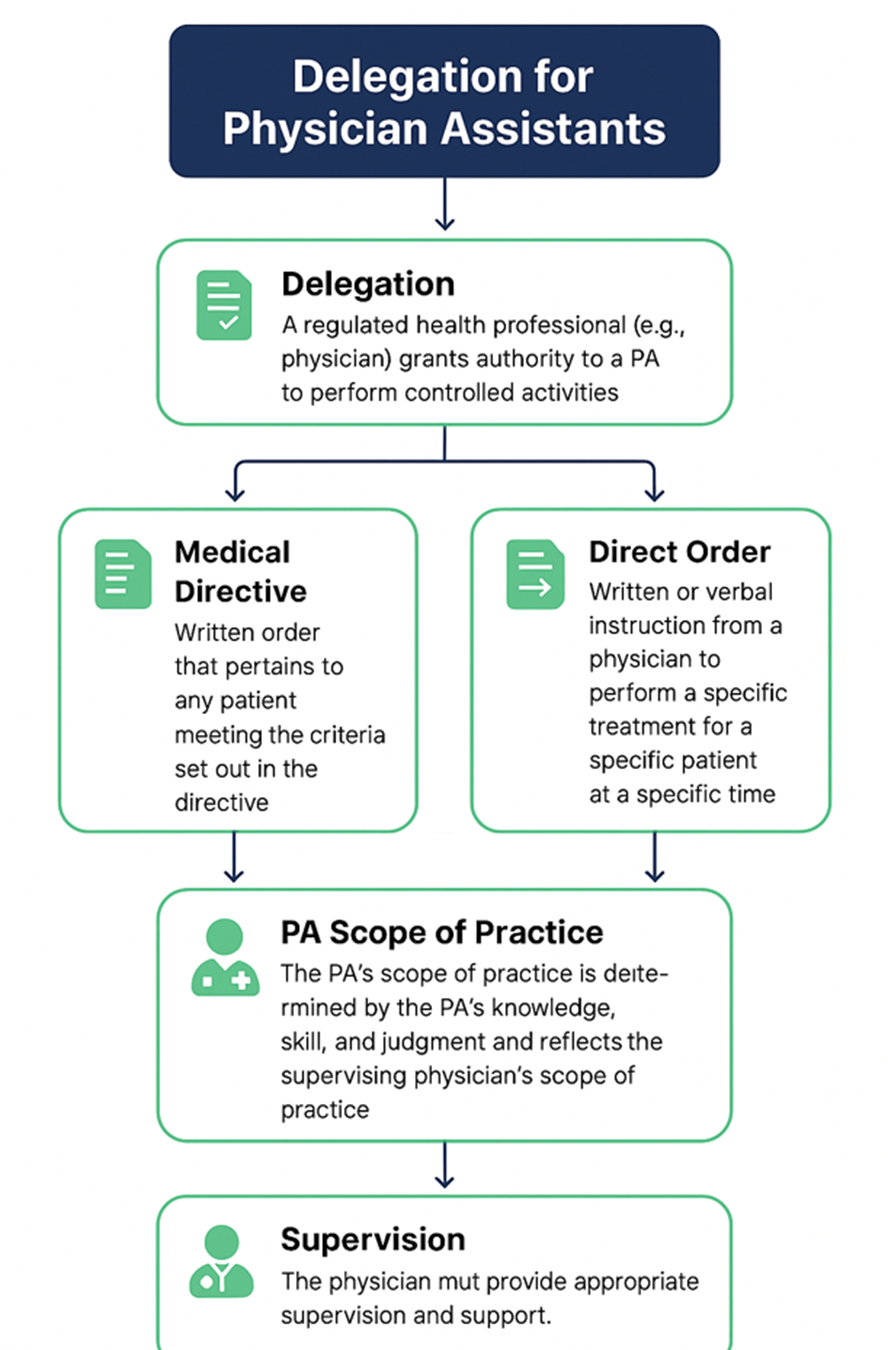
- Reflects the supervising physician’s scope of practice.
- Depends on the PA’s knowledge, skill, and judgment.
- Varies with the PA’s education, training, and experience.
- PAs function as physician-extenders, providing medical services under supervision.
3. Purpose of Regulation
- PAs have been practicing in Ontario since 2007.
- Regulation ensures:
- Safe, high-quality healthcare.
- Clear registration standards.
- Competency based on knowledge, skill, and judgment.
- It maintains the existing delegation framework.
4. Controlled Acts
- PAs cannot perform controlled acts independently.
- Such acts must be:
- Delegated by a physician.
- Conducted with appropriate supervision, following CPSO’s Delegation of Controlled Acts policy.
Delegation and Supervision Framework
1. Delegation
- Definition:
A regulated professional (e.g., a physician) authorized to perform a controlled act may delegate that authority to another person who is not authorized to perform it independently.
- Not Required For:
Non-controlled acts such as taking patient histories.
- Forms of Delegation:
- Medical Directive: Written orders for patients meeting specified criteria.
- Direct Order: Written or verbal instructions for a specific patient at a specific time.
- Reference:
CPSO’s Delegation of Controlled Acts Policy and companion Advice Document.
2. Sub-Delegation
- Definition:
When a delegated individual passes that authority to another person.
- Status: Prohibited under the Regulated Health Professions Act (RHPA).
- Exceptions:
- First aid or temporary emergency assistance.
- Activities during training under supervision.
- Religious treatment (e.g., prayer).
- Certain household care tasks (e.g., insulin injections, catheter care).
3. PA Students & Training
- Supervision:
PA students may perform controlled acts under supervision; this is not sub-delegation.
Example: A PA supervising a student performing a joint reduction.
- Signing Orders:
PAs may sign student orders if covered by a medical directive. Without one, the supervising physician must co-sign.
- Teaching Role:
PAs may assist in training medical students or residents without restrictions.
4. Communication & Collaboration
- PAs may communicate physician orders to other regulated professionals via medical directives.
- Such orders are considered physician orders, not PA orders.
- Example: A PA conveys a physician’s antibiotic order to a nurse.
5. Physician Supervision
- Onsite presence is not always required.
- The level of supervision must match the risk of the delegated act.
- Supervising physicians must be available for consultation.
- PAs may have multiple supervising physicians; however, a lead physician is recommended for accountability.
6. Psychotherapy
- The controlled act of psychotherapy includes:
- Treating
- Using psychotherapy techniques
- Within a therapeutic relationship
- Addressing serious mental disorders
- Potentially impairing functioning or judgment
- PAs cannot be delegated psychotherapy due to its sensitive nature.
- They can provide supportive counseling, education, and health guidance.
7. Prescribing Medications
- PAs may prescribe only through delegation via a medical directive or direct order.
- Prescriptions must include:
- Statement of delegated authority (directive/order number)
- Authorizing physician’s name and contact information
- PA’s name, contact information, designation, and signature
Registration and Licensing
1. Provisional Licensing
- CPSO does not issue provisional PA licenses.
- Graduates awaiting certification may work under delegation but cannot use the title “Physician Assistant” or “PA.”
- Acceptable titles: “PA Graduate” or “PA Candidate.”
2. Leave of Absence
- PAs on leave (e.g., parental leave) as of April 1, 2025, who are not using the PA title, do not need to register.
- They must register before returning to practice.
3. Canadian Armed Forces & PA Integration Program Graduates
- Eligible to register within two years of regulation taking effect if they were practicing in Canada during that period.
- Armed Forces PAs providing civilian care in Ontario must register with CPSO.
4. International Applicants
- Foreign-trained PAs:
Registration currently applies to Canadian and U.S. accredited PA programs.
CPSO may consider others in the future.
- Internationally Educated Physicians:
May practice through delegation but cannot use the PA title unless registered.
5. Registration Requirements
Applicants must provide:
Application Materials
- Completed application form
- Application fee: $300
- Annual membership fee: $425
- Curriculum vitae
- Criminal record check
- Proof of Canadian citizenship or permanent residency
Documents Sent Directly to CPSO
- Official transcripts from an accredited PA program
- Confirmation of good standing from previous regulators
- Reference forms (e.g., supervising physician)
- Additional documents as requested by CPSO
Professional Practice Requirements
1. Professional Liability Insurance
- Mandatory for all regulated PAs.
- Minimum coverage: $10 million, issued by an Ontario-licensed insurer.
- Must include:
- Regulatory complaint coverage (CPSO)
- Civil proceedings
- Group coverage available for CAPA members through BMS Canada Risk Service Ltd.
2. Continuing Professional Development (CPD)
- Annual CPD participation is required; proof must be provided to CPSO.
- CPD standards set by:
- PACCC (Canada)
- NCCPA (U.S.)
- Resources available via CAPA or NCCPA websites.
3. Compliance with CPSO Policies
- PAs must comply with:
- Regulated Health Professions Act, 1991
- Medicine Act, 1991
- Relevant CPSO professional policies
- Until PA-specific policies are developed, PAs should follow applicable CPSO physician policies.
4. OHIP Billing
- Physicians may bill OHIP for delegated procedures in limited cases.
- Refer to the General Preamble to the Schedule of Benefits – Delegated Procedures.
- Billing inquiries should be directed to the Ministry of Health.
CPSO Physician Assistant (PA) Checklist
Use this checklist to prepare before April 1, 2025, or before returning to practice.
1. Registration
- Register if using the title “Physician Assistant” or “PA.”
- Eligible applicants:
- Graduates of accredited Canadian or U.S. PA programs.
- Canadian Armed Forces or Ontario PA Integration Program graduates (within 2 years).
- Required documents:
- Application form + fees
- CV, criminal record check, proof of citizenship/residency
- Official transcripts, good standing confirmation, references
2. Delegation
- PAs can continue working under delegation without the title while awaiting registration.
- Controlled acts require delegation; non-controlled acts do not.
3. Liability Insurance
- Minimum: $10 million coverage.
- Must include protection for CPSO complaints and civil claims.
- Group plan available via CAPA/BMS Canada.
4. Continuing Professional Development
- Maintain CPD compliance through PACCC or NCCPA.
- Submit annual proof to CPSO.
5. Policy Compliance
- Follow the RHPA, Medicine Act, and CPSO professional standards.
- Adhere to physician policies where PA-specific ones are not yet available.
6. OHIP Billing
- Physicians may bill for delegated acts only in limited, approved cases.
- Refer to the Schedule of Benefits; direct questions to the Ministry of Health.
✅ Quick Action Steps Before April 1, 2025
- Confirm title usage and register with CPSO if required.
- Submit all application documents early.
- Verify liability insurance coverage meets CPSO standards.
- Maintain and document CPD activity.
- Review CPSO policies relevant to PA practice.
- Understand OHIP billing limitations for delegated acts.